• 0 Items - £0.00
    • No products in the cart.

£69.99

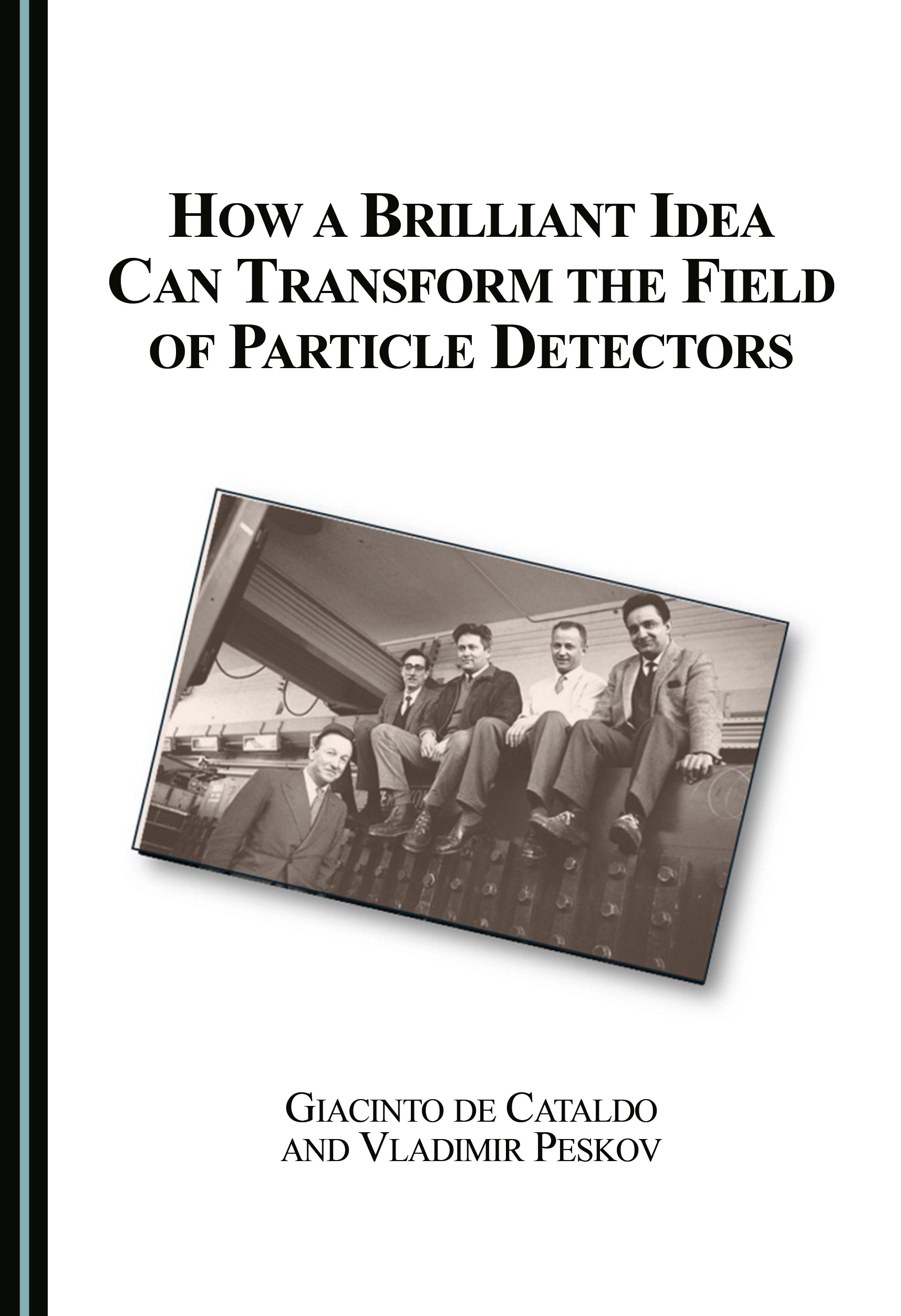
How a Brilliant Idea Can Transform the Field of Particle Detectors

Giacinto de Cataldo, Vladimir Peskov

£69.99

In 1968, Georges Charpak’s revolutionary invention—the Multiwire Proportional Chamber—transformed how physicists explore the subatomic world. This book traces the journey of that breakthrough, a tribute to human ingenuity and a call to future innovators.

In 1968, Georges Charpak introduced a deceptively simple yet revolutionary invention—an electronic particle imaging detector known as the Multiwire Proportional Chamber—that profoundly transformed how physicists…
£69.99
£69.99
Share

In 1968, Georges Charpak introduced a deceptively simple yet revolutionary invention—an electronic particle imaging detector known as the Multiwire Proportional Chamber—that profoundly transformed how physicists explore the subatomic world. This book traces the remarkable journey of that breakthrough idea, from its inception to its lasting impact on experimental physics.
By dramatically enhancing data collection and enabling major discoveries at CERN and other research centers, Charpak’s innovation turned a critical bottleneck into a powerful driver of scientific progress.
Written for a broad audience—including students, educators, young researchers, and engineers—this book blends clear explanations of core physical principles with insightful technical details of particle detector instrumentation. More than a chronicle of a scientific achievement, it is a tribute to human ingenuity and a call to future innovators to embrace curiosity, creativity, and the spirit of discovery.

Giacinto De Cataldo is an Italian physicist of the Istituto Nazionale di Fisica Nucleare (INFN), leading two international projects within the ALICE (A Large Ion Collider Experiment) experiment at CERN. He also lectures in Particle Physics (PHY3232) at the University of Malta. From 1987 to 2000, he was involved in research on cosmic ray composition and led research and development activities for a large-area Transition Radiation Detector (TRD) designed for installation in underground laboratories for cosmic ray studies. Beginning in 1995, he participated in two missions in collaboration with the University of New Mexico (USA) and NASA, aimed at searching for primordial antimatter in primary cosmic rays using spectrometers flown on helium-filled stratospheric balloons.

Vladimir Peskov is a professor and visiting scientist at CERN, currently affiliated with the University of Bari in Italy. From 1971 to 1985, he worked at the Physics Laboratory of the Russian Academy of Sciences in Moscow—led by Nobel laureate P.L. Kapitza, where he conducted research on ultrahigh-frequency plasma phenomena. During this period, he developed innovative plasma diagnostics methods based on a Multi-Wire Proportional Chamber (MWPC), which led to the discovery of new phenomena in plasma physics.
From 1986 to 1992, Peskov was a scientific associate at CERN, working in the Charpak group. His primary achievement during this period was the development of gaseous detectors combined with CsI and other solid photocathodes.

Hardback

  • ISBN: 1-0364-6674-4
  • ISBN13: 978-1-0364-6674-9
  • Date of Publication: 2026-03-30

Subject Codes:

  • BIC: PHP, TBY, PDR
  • BISAC: SCI051000, SCI076000, SCI034000, TEC057000, TEC056000, TEC064000
  • THEMA: PHP, TBY, PDR
349

Meet The Author

Processing Your Order

Please wait while we securely process your order.
Do not refresh or leave this page.
You will be redirected shortly to a confirmation page with your order number.