• 0 Items - £0.00
    • No products in the cart.

£75.99

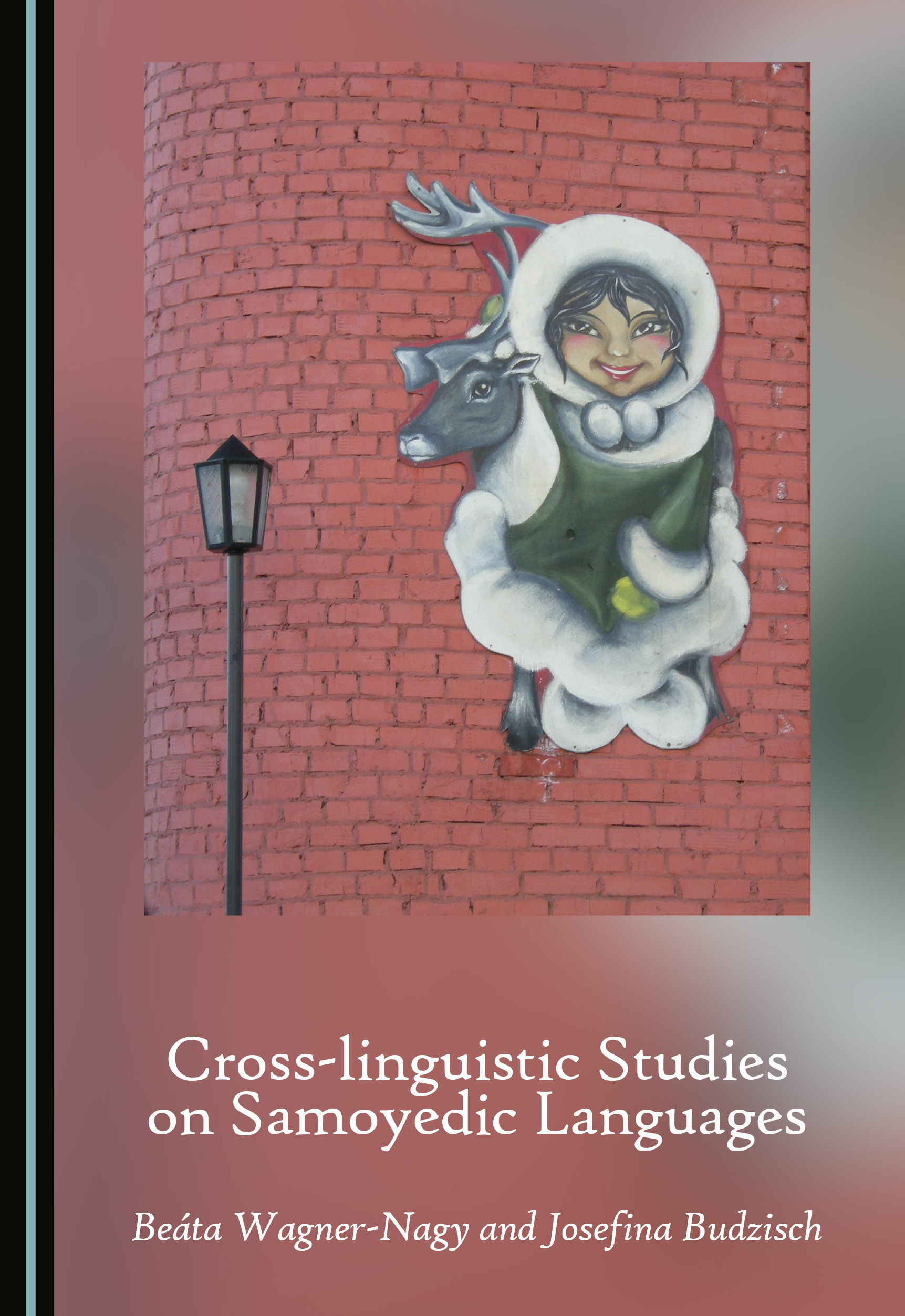
Cross-linguistic Studies on Samoyedic Languages

Beáta Wagner-Nagy, Josefina Budzisch

£75.99

This book offers a comparative, typological study of the Samoyedic languages, a branch of the Uralic family. It explores grammatical variation, offering new insights into linguistic diversity and contributing to the documentation of these endangered languages.

This book provides a comparative study of the Samoyedic languages, a branch of the Uralic language family. It explores grammatical variation across the six Samoyedic…
£75.99
£75.99
Share

This book provides a comparative study of the Samoyedic languages, a branch of the Uralic language family. It explores grammatical variation across the six Samoyedic languages: Nenets, Enets, Nganasan, Selkup, Kamas, and Mator. The study takes a synchronic, typological perspective, highlighting structural diversity rather than historical reconstruction. Based on primary and secondary data, the book contributes to typological research and the documentation of endangered languages. Key topics include phonetic variation, case marking, number marking, and auxiliary constructions. In addition to examining language-internal structures, it discusses patterns of variation across dialects and the implications for the classification of Samoyedic within Uralic. By focusing on underrepresented linguistic structures, this study offers new insights into comparative linguistics and the diversity of the Uralic language family, making it a valuable resource for linguists, typologists, and scholars in Uralic studies and language documentation.

Beáta Wagner-Nagy is a Professor of Uralic linguistics at the University of Hamburg, Germany and director of the Institute for Finno-Ugric/Uralic Studies. She specializes in the documentation and analysis of Samoyedic languages, language typology, and linguistic variation. After earning her PhD in 2000 on Nganasan deverbal suffixes, she held research and teaching positions at universities in Szeged (Hungary), and Vienna (Austria). In 2010, she was appointed to Hamburg, where she has since led significant research on endangered Uralic languages.

Josefina Budzisch is a Research Fellow at the Institute of Finno-Ugric/Uralic Studies at the University of Hamburg. She completed her PhD in Uralic Studies in 2021 with a thesis on definiteness marking in Selkup. Since 2022, she has been affiliated with the Indigenous Northern Eurasian Languages (INEL) project, focusing on Nenets. She has a long-standing interest in Selkup, having worked on it in previous projects.

Hardback

  • ISBN: 1-0364-6600-0
  • ISBN13: 978-1-0364-6600-8
  • Date of Publication: 2026-02-24

Ebook

  • ISBN: 1-0364-6601-9
  • ISBN13: 978-1-0364-6601-5
  • Date of Publication: 2026-02-24

Subject Codes:

  • BIC: CF, CFF
  • BISAC: LAN009010, LAN009020, LAN009060, LAN011000, LAN009000
  • THEMA: CF, CFF
315
  • "The authors are very experienced in the field and can be undoubtedly trusted to provide the most accurate and up-to-date information on this branch.
    - All in all, I beli[e]ve that the proposed book is going to be a valuable contribution and fill an important gap that now exists in the literature on Samoyedic languages." Timofey Arkhangelskiy,
  • "[This book] is aimed at presenting the Samoyedic languages to the wide linguistic community. The authors do not attempt to describe in detail the systems of the six languages and their dialects; instead, they select and show some typologically untrivial features. This is an original and bold solution: I am not aware of any other books of this kind."
    - Valentin Gusev, Institute of Linguistics, Russian Academy of Sciences
  • "The Cross-linguistic studies on Samoyedic languages provide a phonetic/phonological, morphonological, and morphological description of six Samoyedic languages and their varieties. The work does not offer an overall survey of all characteristics in these areas; rather, it focuses on significant features that highlight the diversity or similarity of these languages from a typological perspective. The typological approach is the main strength of this volume, as systematic typological-comparative descriptions are notably absent in the studies of Samoyedic and Uralic languages in general.
    - Another advantage of this work is that the descriptions are data-driven. Language material is sourced from a wide variety of references, including corpora, which also provide background details on metadata for further insights. Essential background information on the sociolinguistic status of the varieties is included in the introductory sections, aiding in the understanding of the discussed phenomena. The selection of topics is deliberate and well-justified, placing great emphasis on the primary typological characteristics of the languages. Special attention should be given to the short section on Placeholders (p. 197), which is not frequently addressed in typological or Uralic studies. When necessary, historical context is provided for a better understanding of various phenomena.

Meet The Author

Processing Your Order

Please wait while we securely process your order.
Do not refresh or leave this page.
You will be redirected shortly to a confirmation page with your order number.